Showing posts with label luther. Show all posts

Thursday, May 08, 2025

The Kind of Bishop We Need


              Since our Bishop announced that she would not be seeking re-election, I’ve been reflecting and praying on that call, both what kind of leader the Synod needs next, and if I might be that leader. I’ve explored my internal sense of call, checked with close friends if they sense an external call upon my life, and reflected on the needs of our Synod. I’ve also paid serious attention to Bishop Bartholomew’s words about the office as she has practiced it and taken some time with the questions in the discernment tool from the Synod as well.

I don’t think it is me. As a leader I am still too reactive, I personalize too much, and default to reflection instead of action; in general, I still have plenty of room to grow and rough edges to tame.

              I do worry that the timing of my growth as a leader and the uncertainties surrounding my heart condition may interact in a way that the office of Bishop will never be my calling. There is certainly a sense of loss in that—I’m a pretty with-it pastor, and believe I could lead well in the church I love—but there is something freeing as well; I’m not Strider or Gandalf, I’m Tom Bombadil or Radagast. Most likely the only thing I’ll ever be the bishop of is whimsy.

              So, freed of all ambition and desiring only the gentle upbuilding of the Kingdom of God and the flourishing of the Gospel of Jesus Christ, here is what I believe our Synod needs to look for in a Bishop.


They Have a Plan

              As the child of two free spirits and a student of Clausewitz, I know that everything in life is ad libbed and that “no plan survives first contact with the enemy.” That said, having no plan is planning for the status quo and “without vision the people perish.”

              Our next Bishop needs to have a sense of what they would do as Bishop. If their plan begins and ends with “won’t I be a good Bishop” that is a red flag to me. They need to cast a vision and name where they think the Holy Spirit is leading us. Additionally, there will be many congregations closing in the next 6 years; the next Bishop needs to articulate a plan for that!

Here is the vision I developed in my time of discernment; it might be a useful conversation partner for anyone in discernment about the role.


They are Sinners and Know the Cross

              Did you know the original quote was not, “The road to hell is paved with good intentions,” but instead, “The road to hell is paved with the skulls of Bishops.” The office of Word and Sacrament, and the office of the Bishop still more, is a position of leadership where you have to make decisions while publicly struggling against Sin, Death, and the Devil; you make mistakes, and you have to find a way to keep moving. You sin, you fall short in this vocation (and yes, in every other one as well) and cling to God, the God revealed on the cross—no scent of success no pleasant features, only trustworthiness.

              One of the things our current bishop returns to from time to time, and you can tell there are both wounds and scars there, is dealing with misconduct and representing the Synod in court. Having done versions of both within the context of pastoral ministry, I can affirm they lead to sleepless nights and exact a heavy toll. And it is not just your own conscience that assails you, but every naysayer and second guesser comes out of the woodwork and watches and waits to pay you their two cents. There is Anfechtung and tentatio embedded in both of these tasks.

              When I was ordained, Bishop Riley’s sermon included an insistence that part of ministry is finding a way to get to sleep at night; there is always one more task, there is always one more failure that won’t stop bothering you. For me, I keep on keeping on by praying every morning that God would make me faithful and thanking God every evening that Christ is faithful.

              So, what does this mean practically, as we choose a new Bishop? Anyone who peddles and promises success upon success or can’t answer the question: “Name a time in ministry when you’ve failed, and what you did next?” Anyone who lacks a firm faith rooted in the forgiveness found every time we return to the font, or blames someone else when criticism comes their way, is not fit for the office.


They Understand the Challenge

              George Orwell famously wrote, “To see what’s right in front of your eyes takes a constant struggle.” I hope and pray our next Bishop will be in that struggle, seeing the challenges of today clearly. Ours is a time of crisis, and has been for years. Our next Bishop needs an existential understanding of the day-to-day challenges of parish ministry, both the mundane and the profound. Our next Bishop needs to be able to focus on that which matters most and navigate the waters in which we do ministry.

              At least for me, my conceptual framework, the 4Ds, do that. There is both the single needful thing—our ability to trust in God at all, and the context in which we do that, one that is dispersed, diverse, and disestablished. We don’t need a 4D Bishop, but we do need one who equips the Synod to navigate the world as it is, and one who never loses sight of our work, the proclamation of the Gospel.


They Feel the Oddness of Syn-od

              There is an often unspoken tension within one of our Synod’s core values, interdependence. So too a tension in the very nature of Synod (the etymology of which is odd people next to each other, right?… oh no, sorry, it’s accompanying along the way…). I hope that the next bishop has a heart torn with that tension, the tension of the ELCA’s three expressions. In fact, I hope the whole Bishop’s office publicly wrestles with their role as the bridge between the local and national church, while still being their own unique expression.

              Having seen that tension up close on Synod Council, as a District Dean, Cluster Counselor, and Vice Pastor, I hope a new balance can be struck; I hope the Bishop will woo local congregations near and far from the Synod office into a posture of deeper relationship and responsibility toward the larger church. I hope she or he brings the best of Churchwide to the congregational level, and that their Assistants foster fresh collaboration among congregations and Synod. I hope we can continue to walk together meeting Jesus along the way, the Synod office equipping congregations as only they can, while caring for the whole, upbuilding and bringing together for the sake of the ministry.

              So much of this will only occur if the whole Synod, both office and congregations, are committed to doing the work that makes for healthy, functioning, congregations. There are so many tasks, so many good tasks, required of us, but if we aren’t equipping congregations to do the basics that are foundational to doing complex ministries, we will become a few endowed and flagship congregations attached to a middle judicatory, which is not the same as a Synod. This sort of work is not inspirational, but it is necessary.


They Reflect and they Act

              Finally, the next bishop needs to both act and reflect, and then act again. They need to regularly enter into the Hermeneutical Circle in which ideas become concrete, and then those concrete actions lead to deeper thoughts, which in turn lead to new creative acts. They can neither be captured by ideas to the point of immobility, nor can they rely on the manic heat of hyperactivity to “flood the zone” or be a substitute for well thought through actions. We need someone who is comfortable both on the dance floor and the balcony above seeing the big picture.

They need to be a questioner—asking second and third level question… “What then? What then? What then?” Following, like a bloodhound, the logical likely outcomes, and consequences, always aware of the probabilities that they have missed something along the way.

In short, we need the amalgamation of a monk and a scientist, someone who will model for all of us, the whole Synod, a method for becoming something new.


Conclusion:

              In conclusion, I hope that our next bishop: has a plan, is comfortable with failure and clear eyed about the challenges of ministry today, is infectiously collaborative and can seed an attitude of experimentation throughout the Synod. Come Holy Spirit Come!


Thursday, October 26, 2023

Ten Theses on the Lutheran Reformation


Intro: After 500th year, we ought to commemorate instead of celebrate the Lutheran Reformation. This means considering how the reformation was in continuity with the Church, the crisis of the Reformation period, and the continued relevance of the Lutheran reformation.


The Lutheran Reformation was Necessary.

-Salvation, Authority, Worship, and Christ were all on the table in Luther’s day.


The Lutheran Reformation was a call for the Church to Repent.

-Repentance is a return.

-Repentance is to rethink.

-Repentance is to reform.


The Lutheran Reformation continues to be Necessary.

-The watchwords of the Reformation are good interpretative lenses.

-The Church still needs reforming.

-The World still needs to hear the Gospel.

Tuesday, August 15, 2023

Being a Pastor: 12 years on

The 12th anniversary of my ordination and my 40th birthday are both coming up next month. I served in two different contexts through a pandemic, I’m heading into the 3rd year at my second call, and am also finishing up a 14-month Vice Pastorship. 

With all that, I am feeling a bit reflective regarding ministry these days. I recently remembered a post I wrote two years into my first call, back when I thought I had it all figured out. It was titled: To Do: A barebones list of the pastor’s task as I understand it and it is quite good, well worth a read. I thought, with an extra decade of experience, I might offer a similar post. This post looks at the pastoral task with a wider scope, less a week-to-week list and more long-term themes of ministry. Less about doing and more about being.

Name the core of your ministry, at least for yourself:

                  This job is weird; you are writing up a report for the council one minute, sitting with someone who is dying the next, choosing between two or three seemingly identical copiers, interpreting a 2000-year-old document in a way that is faithful to its original meaning and relevant to today, and then pushing carts full of food to people’s cars at the food pantry. I think of this experience as Ministerial Whiplash. On top of experiencing the variety of ministerial tasks, there is perception of these tasks. There are literally hundreds of people (both in the congregation and outside it) who have assumptions and definitions of what your job as pastor is and ideas about how you ought to do your job. Because this job can be so multifaceted, almost all of their definitions are at least a little true. 

Even the standard definition of Ordained Ministry in my denomination—Word, Sacrament, and Other Duties as Assigned, falls apart when it comes to that third part. Duty is broad and the question of who is doing the assigning is awkward, to say the least.

                  So, every 3 to 6 months, take stock of what you understand faithful ministry to be, and keep that definition close at hand, perhaps review it once a week. For example, the current iteration of what I understand ministry to be is: Receive God’s Grace, Share Agape, Spread the Gospel. That might sound too simple to be useful, but it is the lens I try to look at all the ministry tasks that come across my desk. It keeps me grounded when the weight of ministry starts to grind me down or blow me off course.

Be clear about time use:

                  This is a two-fold task. 

On one hand, have a system in place to process all the things you need to get done in a week. I use an eclectic hybrid of Getting Things DoneHow to Squeeze Blood from a Turnip, and Sunday Comes Every Week

Additionally, I create a weekly chart with each day cut into thirds. I prioritize by day all my known tasks for the week and order the week for myself in a way that I have a third of a day that isn’t work each day, and one day off a week.

For example:


Monday

Tuesday

Wednesday

Thursday

Friday

Saturday

Sunday

Morning

X

X


X

X


X

Afternoon

X


X

X

X


X

Evening


X

X


If you don’t control the parts of ministry that are in your power, you have no chance of riding the unexpected parts of ministry to a faithful place.

                  On the other hand, it is important to define what is and isn’t work for you—so define what you understand to be your pastoral vocation. For example, for me, morning prayer, edifying Christian reading (even when it leans in a continuing education or bible study preparation direction), and evening devotional bible reading are not work, not part of my vocation as an ordained person. Instead, they are part of my vocation as a baptized Child of God.

This division might seem pedantic, but one of the dangers of the ministry is to simply be a “professional Christian” instead of a Christian called out of community to administer Word and Sacrament. This danger is two-fold: 1. the laity of the community can never measure up to your “expert Christian” doings and 2. you can become so professional that you cease to be Christian, the ordination rite supersedes the Baptismal sacrament—The road to hell is paved with the bones of bishops and the skulls of priests.

Protect the vulnerable:

                  This is a hard one to write about. Without saying too much, there are abusers and predators out there, both ordained and lay, who see the Church as a place to misuse power and its ministries as existing for their personal gratification. You will encounter theft and graft, physical, mental, and sexual abuse, power plays and hurt people hurting people.

You are the fluffy sheepdog among the flock who puts the wolves on notice. Your job is to be the “bad guy” who asks the right questions, notifies the right authorities, and stands between the predator and the victim.

I say that you’re the “bad guy,” because doing the right thing often means conflict and consequences, and most people really don’t like either of those things.

The cavalry isn’t coming, but colleagues care:

                  One of my naivetés early on in ministry was an assumption that a Presiding Bishop or a Seminary Professor figure would swoop in and save me if things got really bad. It took me a frightening ER visit with chest pains that turned out to “just” be a panic attack to realize that, as a solo Pastor, no one else will take care of you. There are no training wheels; this is a live fire exercise. The buck stops with you, especially when it comes to your own health and safety.

                  There is a saying attributed to Luther, “The Pastor is the Bishop of their congregation.” Now some folk cling to this quote because they think that makes them the answer person in their congregation, or it allows them to boss people around, or what have you. But this quote is getting at the buck-stops-here-ness of being a Pastor. You are the most responsible person in your ministry context. 

                  That said, there are colleagues out there who will have your back. Go to Synod things, be active in your cluster/district/whatever they call a grouping smaller than a Synod where you are, do what you can keep those connections fresh; relationships take practice. Ministry done alone is just asking for the devil to swoop in and poison all you’ve done.

Partner with everyone, as long as they play nice:

                  There has always been a Pentecost sort of ideal in the Christian faith, that diverse communities sharing their unique gifts with one another as partners is good and holy. Sadly, for most of Christian history denominations and congregations were too well off to live into that ideal—this period of self-sufficiency and relying on a variety of props rather than the Gospel and the Spirit, is often called Christendom. Well, as Christendom is rightly humiliated for its sins, Christianity may now be in a place where we HAVE to live into that ideal.

As such, connecting with communities and organizations around you who do parallel good works is paramount. Be interested in what ecumenical partners are up to and consider how you can be faithful together. Consider too the ways secular organizations might be doing Gospel work unaware and see if you can join them in it!

That said, the humiliation of Christendom doesn’t always goad congregations to the Christian ideal of healthy partnership, and secular organizations don’t always get the church. Sometimes potential partners are unhealthy or even predatory. Secular organizations can see your membership roll as a donor list. Unhealthy congregations can see another congregation as a thing to be cannibalize for spare parts, offers of Christian partnership can be taken as a thing to be consumed in the hopes of returning to the ill-gotten riches of Christendom.

So, as with most things in ministry, be open, but also trust and verify. Discernment is key. 

Summary:

                  Between my initial more granular take on ministry and my current crop, there are 15 bits of advice. Some overlap and some contradict. The earlier seem a little more optimistic and surer, the latter more tentative and cautious. I’m writing them down as an exercise for myself—externalizing my ruminations, but maybe some of them will be helpful for other people in ministry as well.

I can’t wait to see where I am at in defining my pastoral task in another decade’s time! What wisdom will more years of ministry and more grey hair in my beard lend to me?

Friday, July 28, 2023

What is Church? How should we reconstitute it?


Perhaps as prologue to considering how we ought to reconstitute the ELCA, we ought to pause and consider what is the Church? Now, I’ve done an educational series on this question at both congregations I’ve served as pastor. Here are a few things from that series worth considering:


The Church is what happens on a congregational level, and that varies greatly by congregation. Congregations define themselves by:
-who they are not (for example, the congregation was founded by people dissatisfied by the other Lutheran congregation in town)
-what they do (for example, “we’re the congregation who feeds people” “we’re the congregation that holds the craft fair in November”)
-by their history (“we’re a Muhlenberg congregation founded before the country” or “we found our identity as a congregation when tons of WWII refugees moved into the neighborhood in 1951”)
-ethnic heritage (we’re a German congregation, we’re a congregation of “Squareheads”, etc).
              As such any definition of Church, and any restructuring of church, has to take into account a certain amount of diversity.


The Church is defined in particular ways by Lutherans.

The third person of the trinity, the Holy Spirit, creates and keeps the Church. (Luther’s Small Catechism)

This creation of the Holy Spirit is people gathered around scripture and sacrament. That’s it, other things are fine, but are of human origin. (The Augsburg Confession, 7th article)

This gathering will include saints and sinners, true believers and false Christians, righteous people and hypocrites. Bad and wrong folk don’t render the Church null and void. (The Augsburg Confession, 8th article)

So, in reconstituting the ELCA we need to remember: that we’re always stewards of what God has first done, not to elevate or fixate on non-essential things, and make organizational decisions knowing they’ll be administered by humans not angels.


The Church has been defined in the ELCA’s constitution. There is some really thoughtful stuff already present in how we do church, and I hope we don’t jettison it. For example:

Jesus Centered: To quote directly from the constitution, “All power belongs to Jesus, our actions carry out the will of Jesus Christ.”

Humble Ecumenism: We recognize we’re not the entire expression of the Church, as such we describe the ELCA as “This Church” not “The Church” which we understand to be much wider than the ELCA.

Mutuality: At our best we’re three expressions of This Church, the local Congregation, the regional Synod, and the national Churchwide. We are accountable to one another.

Worshipful: Every major decision in our denomination is made by a group of people in worship. Congregational Meetings are made by people assembled for Sunday worship, Synod Assemblies are a worship gathering of people from every congregation where the business of the Synod is discussed, and Churchwide Assembly is a multi-day worship event that also involves major decisions for the life of this Church.

              I pray the reconstitution of the ELCA is worshipful, gathers consent from all the expressions of This Church, takes into account our commitments to other Christian bodies, especially those who we are in full communion with, and most importantly, the changes are done in order to more fully carry out the will of Jesus Christ.


              Another way to come at the nature of the Church is to name “What Christianity is Not” as Douglas John Hall does in his book of the same name. According to this book, Christianity is not:

Culture: It is not tied to a country, or subculture or people or ethnicity. St. Paul struggled with defining the bounds of the faith in ethnic/cultural/religious divisions. St. Augustine did the same vis a vis Rome and Kierkegaard vis a vis Denmark.

Religion: As stated above the Church isn’t a method for humans to reach heaven, but a gift of the Holy Spirit.

A book: The Reformation slogan “Word Alone” isn’t the same as Bibliolatry, but the experience of encountering the God pointed to in the Scriptures.

Doctrine or even Truth: Ultimately faith isn’t a matter of cognitive affirmation to particular points of view, but trust in the God found in Jesus. Being found by God.

Morality: As said above, the Church will by its very nature be filled with both saints and sinners, often found within the same person.

The Church: The whole of the book of Acts is the church catching up to what the Spirit has already done.

              So, after going through all these things that Christianity is not Hall defines Christianity as “When Jesus is proclaimed and experienced as Crucified, yet Lord and Prophet.”

              How might this help the reconstitution of the ELCA? It names six important aspects of Christianity that are so important that we have a tendency to think they are the ultimate concern of the faith, when they are in fact penultimate. For example, a cultural or moral concern could scuttle a reconstitution discussion, but with the above in mind can be relativized in the light of the most important thing, our Crucified Lord. Also, I pray that the folk involved in these conversations always keep open for experiences of Jesus as Crucified Lord. 


              So, at the end of my congregational educational series, how did the group I was leading mash up these ideas into a working definition of Church? “A community who trusts in Jesus Christ, gathers around word and sacrament, and proclaims the Gospel to our neighbors.”

              I pray that the Reformed ELCA, whatever its ultimate shape, will proclaim Gospel to the world, worship together well, and trust Jesus Christ.

Saturday, October 29, 2022

40 Negative Propositions about Lutheranism


 Lutheranism is not…

1.    About what we do, but what God does.

2.    Morality or ethics, but grace and response, grace and response

3.    Bound, but is freed in Christ

4.    About being upright, but being made right by Jesus’ life, death, and resurrection

5.    About self-reliance, but relying on God as a mighty fortress


Lutheranism is not…

1.    The Way, the Truth, and the Life, but witnessing to the one who is all those things

2.    Private, but Evangelical—the impulse to share the good news of Jesus!

3.    Ashamed of the Gospel, but embrace a living daring confidence in God’s grace

4.    Spiritual, but instead embodied in the profoundly common

5.    Triumphant, but students of the God found on a cross

6.    Fundamentalist, but the experience of God’s Word as a two-edge sword

7.    An ‘ism, but a relationship with Jesus


Lutheranism is not…

1.    All Casseroles and Coffee, but receiving the Bread of Life, for you!

2.    Monolithic, but a great variety of people found by God’s grace

3.    An ethnicity, culture, or nation, but a people gathered by God.

4.    Theology, but continual failures to fully name the Divine

5.    A Style of Worship, but whatever actions will make Christ known


Lutheranism is not…

1.    The Only Church, but a spoke of the ecumenical wheel affirming the historical creeds, the Word expressed as Law and Gospel, and sacraments administered rightly

2.    A denomination, but a mustard seed planted for all to find rest within

3.    The point, but compost & leaven to enliven the whole church

4.    Parochial, but Catholic, Global, Universal

5.    Perfect, but always reforming

6.    Limited to Luther, but encompasses all who take his writings and insights to heart

7.    A form of Church Government, but whatever form that allows us to be faithful

8.    Independent, but interdependent with the whole body of Christ


Lutheranism is not…

1.    Having our own way, but respecting one another as God’s Children

2.    A museum of saints, but a hospital for sinners

3.    Putting our heads in the sand, but engaging with the world around us, thinking through faithful engagement with our world with social messages and statements on everything from peace and policing, to education and the economy

4.    Words without actions, but 2% of people in North America are assisted by some sort of Lutheran Social Ministry each year

5.    Exclusionary, but inviting and listening and trying to understand each other

6.    Afraid of questions, but begin our faith life asking, “What does this mean?”

7.    Self-righteous, but trust that God is for us

8.    Anti-Semitic, but repenting and repairing the breach between us and our Jewish friends

9.    Politics, but vocation, roles and relationships lived faithfully

10. Afraid of change, but it is one of our core values


Lutheranism is not…

1.    The purview of our great great great grandparents, but springs from their faith and faithfulness

2.    Old, but always being made new

3.    Frozen, but passionate about matters of life and death, and life again

4.    Dying, but more alive than ever, thriving around the world!

5.    The Past, but for you, right now in this moment, and for everyone who chases after the Holy Spirit into God’s future

Friday, May 07, 2021

A Rose By Any Other Name: Lutheran


So, an Australian Lutheran Seminarian decide to be an Internet Troll, and recently attacked a facebook group connected with my denomination, asking the question: “Why does the ELCA have Luther in their name when he was a racist and sexist bigot?” From what I can gather from his responses to people’s earnest answers to his question, he mainly wanted to tell folk that his version of Lutheranism follows Luther warts and all, unlike those sissies in the ELCA who ordain women and apologized for Luther’s anti-Jewish writings.

Now, his question got me thinking about names. Of course, Luther wanted Lutherans to be called “Evangelicals” but like so many other groups (for example Methodists, Mormons, and Quakers), Lutherans didn’t get to name ourselves. Instead, people hurled the term “Lutheran” at us as an insult, and it stuck.

And I wonder how that name Lutheran, has shaped who we are as a church?

A few counter-factuals:

What if we’d managed to have the name we wanted, Evangelical. Evangelical comes from the Greek word for Good News. Would we have been more diligent in telling people about God’s grace if we’d been known as Evangelicals? Would more people have heard that God loved them even before they loved themselves, if we’d had that name?

For that matter, what if we’d named ourselves after the documents that best describe what we believe, the Confession of Augsburg or the Book of Concord? What if we were Concordians or Augsburgers? Would this decenter the personality of Luther and a corporate identity focused on protesting and “Here I Stand” moments and re-center on celebrating moments of unity?

Or, what would have happened if Luther’s Roman Catholic Order became the descriptor of our faith, what if we identified as “Austere Augustinians”? Would that point us back to the first four centuries of Christianity more than our current identity? Would scripture AND tradition be a watch word for us instead of “Scripture Alone”?

Finally, what if we’d called ourselves Catechismers? That is, what if the commonality we clung to was Luther’s Small Catechism? How might that empower lay folk to explore their many Christian callings? After all, if you are identified with Luther, you probably need to be familiar with his whole history and the giant corpus of his works. If you identify with the confessions, it is fraught with background and a great deal of study is required. But, if that little book, read by parents to children, is the center of it all, wouldn’t more people think “Eh, sure, I can do that!”


Monday, October 30, 2017

Reformation 2017

         Dan and Claire were married for 8 years, it started out great, but they were drifting apart. Eventually Claire spoke up, “Hey, this isn’t working.” Dan replied, “I’m so glad you said something, I’ve felt that way too.” It took a lot of work and some outside counseling, but things got better.
         It had started to go south for Phil when he had an accident on the job and was given more painkillers than he needed. Then he used medication he found in her mother’s medicine cabinet, and he quickly escalated to heroin. His best friends Jason and Jamal sat him down one day, and told him how his dependency on drugs had changed who he was—they intervened, and Phil got into an inpatient rehab place, and afterwards regularly attended NA meetings and, after a few relapses, kept clean.
         Patt and Max were driving from South Plainfield to New York City, and things didn’t look quite right, and after a while Max turned to Patt and said, “Hey, Patt, I just saw a sign for Philly… maybe we should turn around.” And they pulled over, checked googlemaps, and turned around.

         In all these cases it took some courage to say, “This is wrong” and courage, too, to change. To turn around—or to put it in biblical terms, to repent.
Let us pray

         When I think of repentance—of folk forced to look at their situation and be stimulated by the Spirit to spontaneous acts of re-interpretation of the faith, I think of Jeremiah.
         2,700 years ago, the prophet Jeremiah was assessing the destruction of Jerusalem, walking the rubble and ruin of that grand city razed by the Babylonians—his city shattered.
         And down from his depths a question arose, “Why?”
         “What of the promises between God and us? What of the covenant made between God and the people, made between Moses and God?”
         And the horrifying answer came to him, “they broke it! They treated God like a cheated-upon spouse!”
         Imagine that moment! Struck there by his surroundings, and by his despair, and by a need to start again—to turn around, to repent.
         “Oh, Lord,” it seems he is saying, “There is no way out. We can’t save ourselves, look around at our best, blown to bits and blowing away in the wind and ate by the flames of war!”
         And God responds, “I will provide for you a new covenant. An internal promise, one sided and sure, beyond breaking—there will be no separation between you and I this time, because you will know me!”
         God turned the people around, and did a new thing with them!

When I think of repentance—of folk complacent but called to something more, moved to a higher ground and higher calling, I think of the folk Jesus calls to discipleship in John’s Gospel.
1,990 year ago, Jesus calls it like he sees it.
“The truth will set you free.”
Yet these folk with him believe they’ve always been free, smug even with Jesus right there, unable to see where they’d fallen short, unable to see how bound they were.
But Jesus sets before them a Word and a Way—a path to turn onto and follow onward to the Truth and the Freedom found in being a Disciple of Jesus Christ, paved, ultimately, in the unearned adoption into God’s family—reminded that that was Abraham’s origins as well… just some wandering Aramean who God happened to gift with relationship—turning him too toward the promised land, turning Abraham too around, and into the merciful arms of God!
God turned the people around and did a new thing with them!

When I think of repentance—when I think of a Repenter par excellence—someone stopped in their tracks and turned 180 degrees around—I think of the Apostle Paul.
1,960 years ago, Paul had a problem.
He’d met the Messiah, and it wasn’t who he expected at all! The Blessed One died on a cursed tree! Non-Jews joining Jesus’ earliest followers!
He asked, “How is this possible? Aren’t there clear boundary markers? Isn’t that what makes the world of religion go round? Isn’t that righteousness in a nut shell?”
No—he finds, God is faithful to ALL people! The barriers erected, erased, and replaced by God’s love found in Christ Jesus our Lord.
God turned the people around and did a new thing with them!

When I think of repentance—being convicted and convinced by conscience, following after a new Spiritual insight, wherever it may lead—I think of Luther.
500 years ago, Martin Luther looked back at Scripture and at the Early Church, and looked carefully at the church around him—and was convinced something was wrong!
He looked at the penance system that had calcified onto the church and hand clung to it like some parasite.
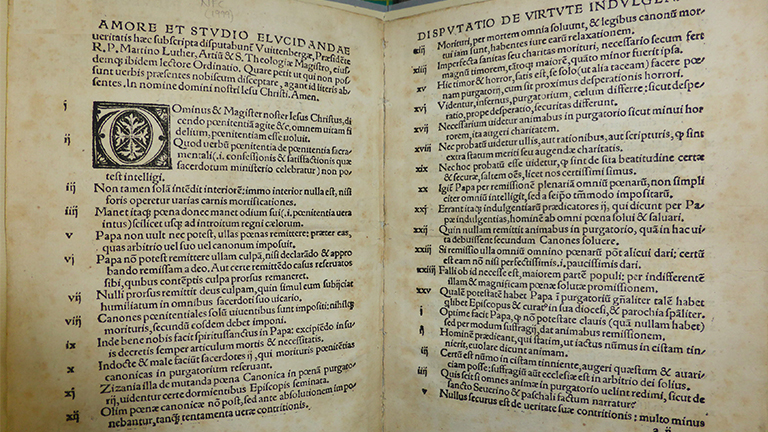
He looked at it in horror, realizing the problem was deeper than the sale of indulgence—get out of purgatory free cards hocked to pay for St. Peter’s Basilica back in Rome.
         Luther noted:
-How the penance system was warping not only his faith life, but the collective life of the Church writ large.
-How it seemed designed to obscure the Grace God promises us,
-designed to ignore that we are adopted children of God,
and to pull at people’s hearts in order to make God’s law again an external thing.

And to this he wrote up 95 points of debate, beginning:
 “When our Lord and Master Jesus Christ said, “Repent” in Matthew 4:17, he willed the entire life of believers to be one of repentance.”
         And the journey that followed the posting of the 95 theses involved:
-sanctifying and splitting,
-a Christian re-thinking of sex and celibacy and the spirituality of work,
-a popularization of scripture reading and child rearing,
-new ways of taking care of the poor among us, engaging with secular power, and finding God where we would least expect God to show up.
God turned the people around and did a new thing with them!

And, just as God wasn’t done with folk 2,700 years ago, or 1,900 some years ago, or 500 years ago… I want you to know God continues to call us to a life of repentance, of turning around, moving from complacency to Christ follower, righteous re-interpretation of the faith, digging down through the layers of our own missteps to recover the grace that is always, already, there!
God is always turning us around and always doing a new thing with us!

A+A