Saturday, January 06, 2024

Heaven torn, a new creation born.


         One of Lisa and I’s favorite shows is “For All Mankind” an alternative history of the Cold War where Russia makes it to the moon first, 

This puts space exploration front and center as the conflict point of the Cold War…

         One of the ever-present dangers in the show is the vacuum of space
—a tiny rip in space suit tears the whole thing wide open, 
a chip on a window can pull apart whole sections of ship or even destroy a lunar base.


         In Jesus’ Baptism at the Jordon, we get just such an unpredictable hole, 
a dangerous tear
—as Jesus comes up out of the water, he sees “The Heavens Torn Apart” 
rent in two—ripped open! 
Yes, at the start of the Gospel, a tear big enough for a dove—the Spirit
—by the end… it is a hole torn wide enough for a new world to enter in! 
Heaven torn, a new creation born.

Prayer


Heaven torn, a new creation born

         There is much in our world that seems to separate us from God and neighbor
—in Mark’s Gospel the major barriers are Stigma and Sin, Illness and Death.

         And maybe those walls humans build up are not confined to the pages of the Gospel, 
maybe Mark picked some timeless categories… 
-maybe we still stigmatize folk who are different than ourselves
—every ism in the human vocabulary… 
-maybe we still judge the failures of others more harshly than our own
—“Hey Preacher, why don’t you talk more about sin”… “no no! Not my sin… that’s guy’s sin!”
-maybe we still look at sickness and misfortune as God’s judgment
—or at least a sign that surely someone did SOMETHING wrong….
-maybe we are so afraid of death, that we don’t live the life God has given to us…
we’re afraid to love because it might lead to loss.

         All of these barriers humanity erects can wreck us, leaving us imprisoned, 
confined to a tomb of our own creating, 
our best bet, repentance and confession
—starting again in the empty desert where John resides…


         Every time we pray the Lord’s Prayer, we pray, “Thy will be done on earth as in heaven.”

         And Jesus can see that reality! 
Heaven ripped open
—God’s will for the world flooding through that pinprick, into our world… 
the Spirit whooshing in and filling us all with new life! 
No one else sees it yet, 
but God is on the loose, nothing will be the same... 
nothing can separate us from God! 

         Don’t believe me? Just look to Jesus!


Heaven torn, a new creation born

         Jesus’ ministry is that of reconciliation
—of bringing holiness to an unholy world… 
of returning the stigmatized to community, 
offering sinners a way home, 
healing the sick
overcoming death.


         Look to Jesus, who the Spirit names as: 
God’s son, the One Who Pleases God, the Beloved…
These titles are also references to verses in Hebrew Scripture, that when you unpack them, map out the ministry of Jesus:

         Jesus is the One Chosen by God, 
to gently right the world, 
by living a life that doesn’t end in death.


         Chosen by God
—anointed for a task, 
like the Blues Brothers, on a mission from God
given a particular, unique, vocation
—role, relationship, and responsibility.

         To Gently Right the World
—to justify, to save, to redeem
—the cart is tipped he’s going to untip it, 
the ship is sinking, he’s going to bail it out, 
the patient is dying, he shall revive her…

         A life that doesn’t end in death
—Resurrection, new life
—do you remember the first time you went to a concert and the crowd called for an encore? 
It felt like it was all ended… 
and then the band bursts back out and wowed you for another magical hour!


         When Mark writes that Jesus is “God’s beloved and pleasing Son.” 
He’s saying Jesus is on a mission to right the sinking ship with an encore beyond imagining. 
That’s what is pouring into this world through that ever-widening tear
—that’s what it means that God is loose in the world!


Heaven torn, a new creation born

         God is on the loose in our lives as well! 

         If you want to look at that gaping hole between heaven and earth
—as it opens wide, 
just look there, 
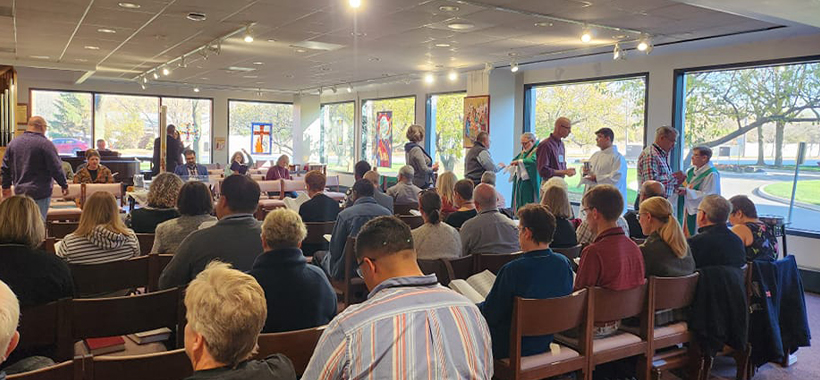
at that font
Just remember that you are baptized.

         In that water is forgiveness, redemption, salvation
—it is pure gift, 
you are accepted, embraced, and moved by the Spirit… 
in it you find a promise that you can trust! God is righting this world! 
In that water is Jesus’ unimaginable encore… Resurrection and New Life!
In it, our calling, our vocation, our mission
—daily die to the Old Creature, that the Human One might emerge!

         Our Baptized life is the continuation of that pinprick in the space suit that Jesus saw
—it is our entrance into the inevitable New Creation. 
It is, even, the New Creation’s entrance into our old life,
nothing will be the same
—God loose among us and in us!


Heaven torn, a new creation born

         The Gospel is first greeted harshly by our world. 
Our world armored and isolated, 
segmented and divided, 
sinking under its own self-defenses, 
desperately in need of saving, 
and God does so, 
sending Jesus on a mission to make all things right, 
rescue God’s good world in a way that ushers in a profound new goodness on account of the intervention.

A goodness we’ve been grasped by in Baptism, 
given a new mission, 
a new life;
Called, Gathered, and Sent by the Spirit.

A goodness that continues to rush into this world, 
filling it and changing it, transforming us all, 
so that we might affirm, “Thy will is done on earth as in heaven.” 
The Spirit is among us and we are a New Creation. Amen and Alleluia!

Tuesday, January 02, 2024

The Chilstrom Map of the ELCA

I recently read A Journey of Grace: The Formation of a Leader and a Church, the autobiography of Herbert W. Chilstrom, the first Presiding Bishop of the ELCA. It was good! I’d recommend it to anyone interested in modern Lutheranism, Christianity in North America, or who just want to read the witness of one man’s faith and life.

At the end of his time as Bishop he offered a series of reflections to the Church Council for how to make sure the ELCA was sustainable. One of them was significantly reducing the number of Synods. On pages 518-520 he offered a reorganization of the ELCA synod structure from 65 Synods to 38. I’m a visual person when it comes to geography, so I pulled out MS Paint and recreated the proposal in map form. Below is the map of what he envisioned.

As a humorous aside, he forgot that the states of Delaware and Alabama existed; I lumped them with their current synods.


Saturday, December 30, 2023

Get involved with a Mainline Church!


Church is good for you

I’ve written about this for quite a while, I am convinced the regular practices of the church, the seven central things, can be a powerful good for a person’s wellbeing and life. In my experience, because of Christian worship I: value and can navigate community, have an increased sense of self-worth, have tools to get over slights and make sense of life, and am more content, generous, and gentle.


Church is good for the world

              Church isn’t just good for you; it is also good for us. Church is a third space, meaning it is a place that is neither work nor home, a space society is in short supply of. It is (or at least should be) a non-partisan space; sometimes the most radical political act is opening up space where people can meet as humans instead of red or blue partisans. It is also a non-commercial space, ideally the church isn’t selling you anything and isn’t trying to part you from your money. I am convinced society is better off when there are places for people to meet together as humans, not consumers, partisans, workers, or even of a particular family. Church can be a space to reflect on all of those identities and vocations without their immediate pressures.


The Church needs you!

              So, pre-pandemic, it felt like the mainline church tradition maybe had a 10-to-15-year window to stabilize and reengage with the Gospel and the world, otherwise we would cease to exist in any meaningful way within a generation. Unfortunately, the pandemic accelerated everything—we probably lost 8-10 years in the last three.

Yes, that means the mainline tradition needs to get our act together by 2025-2030, and if we don’t, we’ll cease to exist in the mid-2030s. As we head into the year of our Lord 2024, I’ll admit that’s a tight window! If Millennials and Zoomers are going to make a move to steer the mainline to the deep sea of the Gospel and the meaningful work of ministering to the world as it is, this is it, this is our shot! Now is the moment where you can make an impact and have a voice like never before.


Now is the Time

              Now’s the perfect time to get involved with or reengage with your local mainline congregation! The urgency of the moment means most every denomination is at a generational turning point and is doing something new. Locally the Presbyterians are restructuring their middle judicatories, the Methodists are finally facing the question of human sexuality, and the ELCA is preparing for a reconstitution convention. There is a space for you to make a meaningful difference in a congregation and a denomination!

              The Mainline still has enough resources for one more push, one more directional change. We can’t do everything, but we can concentrate on doing a few things and doing them well, and likely those things we choose today will be the direction the ship goes for the next decade at least. You can be part of that! I hear all the time people saying, “Hey, why doesn’t the church do X, Y, or Z?” This is the moment where we choose between X, Y or Z; come be a part of it! Be a partner in the Church’s discernment, help us to see where the world and the Gospel intersect at this time and place!

Friday, December 29, 2023

Praying for the Innocent in Palestine and Israel

Pray for the Little Ones

We remember today, O God, the slaughter of the innocent children of Bethlehem by order of King Herod. Receive into the arms of your mercy all innocent victims. By your great might frustrate the designs of evil tyrants and establish your rule of justice, love, and peace, through Jesus Christ, our Savior and Lord, who lives and reigns with you and the Holy Spirit, one God, now and forever. Amen.


Yesterday was the Feast of the Holy Innocents, where we remember those slaughtered by Herod (Mat. 2:13-18). I shared the above prayer on multiple social media platforms, and folk really responded to it, most probably seeing it as a commentary on what’s going on in Gaza; one person explicitly mentioned the 9,000 children killed there.

              Now, for a blog where at one time I commented on everything, quite frenetically, my saying nothing about 10/7 and the invasion of Gaza might seem strange. Well, in the tradition of my wife, the Quaker tradition, there is a question you ask, “Are you improving the silence?” Or to put it another way, would my hot take on the Middle East simply contribute to the noise? I thought so, so I took time to listen; I noticed the people I most trust regarding Israel and Palestine were silent or lamenting.

              The Sunday after 10/7 I did say a few pastoral words to my congregation, essentially, I’ve met Israelis and Palestinians who have worked together every day for decades, middle aged men engaging in commerce, sometimes across or through fences. Folk living their day to day the best they can, do not want war, do not want each other dead or wounded. War and violence rarely cause the powerful and the ideologically driven to be defeated. Those who will be hurt and will die, will be the little ones. We ought to pray for the little ones.


Reasons for Silence

              Since then, I’ve been silent, because it seems like any words of support get warped here on American soil. Compassion toward those murdered and mutilated and raped on 10/7 is transformed into support for Islamophobia; horror at bombs and disease and starvation decimating the Palestinians in Gaza bolsters Antisemitism.

              For that matter, it seems like we can’t even settle on what terms mean. I’ve seen people use “From the River to the Sea” as a way to talk about Gaza and the West Bank becoming an independent country cradling the equally independent country of Israel, and others who use it to call for killing every Jew in the Middle East. Likewise, I’ve heard people saying they are “Zionists” and mean that they advocate for depopulating every country from Kuwait to Egypt, in order to ensure that God will bless America, because God blesses those who bless Israel. I also know people who call themselves Zionists because they believe Israel has a right to exist within the framework of the 1947 UN partition plan.

People are choosing sides like it’s a baseball game, or a twitter poll. We’re picking a slogan and inserting whatever meaning we want into it. We’re excusing the excesses of our own side, because at least they are on our side. We are polarizing and radicalizing in the process, and I don’t want to participate in that!


Who Benefits

              It is worth asking, who benefits from the misery and death of so many?

Hamas, surely, that’s why they provoked Israel, knowing Israel’s response to Hezbollah’s similar provocation years back. Recently, more Arab countries have begun to make peace with Israel while sidestepping the Palestinian question. Hamas’ action stopped that process in its tracks. Peace in the Middle East can only go through Palestine.

Netanyahu, a politician uniquely despised by his own people. His policies toward the Palestinians tended to delegitimize Palestinian Statehood by weakening moderates and strengthening militants; the same militants who eventually attacked the country he was supposed to be protecting. He caused a revolt in his own military when he undermined Israel's court system. He might well go to prison once he is out of power… so keeping the conflict going as long as possible, is in his best interest. His government currently has the legitimacy of a national unity coalition in the face of an external threat, once the threat ends, so does his rule.

Russia, the attack happened on Putin’s birthday, and some say that was not a coincidence. 10/7 diverted US and EU attention, munitions, and funding from Ukraine. Russia can pretend to be a disinterested and responsible third party in negotiations between Israel and Palestine. Russia, not America, is lauded as the force of stability in the Middle East and the wider world.

Iran has declared that 10/7 was retaliation against America for killing their chief spy a few years back. The war in Gaza helps their ally, Russia. It undermines the alliance against them being formed between Israel and the Arab world. Additionally, it has given Iran reason and opportunity to attack US service people, in an effort to gain power in Iraq and set up a sympathetic regime.


Israel’s 9/11

              I’ve thought some about Biden’s warning to Netanyahu that responding to 10/7 like we did on 9/11 would be a mistake. The American people called for things to be smashed to undo the smashing of our precious city, death for death and eye for an eye. Then we occupied Afghanistan for 20 years and Iraq for 12. As I alluded to above, we still have troops in Iraq who Iran is taking pot-shots at.

We could have tackled Al Qaeda as a police action, but we did not. As with many things in global governance, I don’t know enough to second guess that choice, but I do often wonder how different my generation’s formative years would have been if we’d tried to restrain and redeem the evil of 9/11, instead of trying to destroy it.

Does Israel want to still be fighting in Gaza in 2043? Do they want to occupy Lebanon until 2035? Could those who killed, maimed, and raped Israeli citizens be brought to justice by non-military means?

              The other wrinkle in all this is there are hostages out there. A few of them have been accidentally killed by the Israeli army already. Bombs don’t seem to be getting them home; the brief ceasefire did bring some people back. And it be clear, the prisoner exchange did further legitimize Hamas in the eyes of some, so I’m not saying there aren’t consequences to such an action.


Ceasefire

              It seems like war only hurts the least of these. This war is propping up Hamas and Netanyahu, strengthening the hand of bad state actors, and spreading global chaos. War won’t get the hostages back. War encourages radicalization, polarization, and more war. War saps the creativity of people of goodwill.

              For all those reasons, it seems like the best bad option is a ceasefire in Gaza.

I hope saying all this has not created more noise and nothingness, and I surely don’t know enough about the Israeli Palestinian conflict to say as much as I have, but my conscious told me that I had to say something. I pray for the little ones who are bearing the brunt of this conflict, pray that the Spirit might spark a creative way out of this destruction, and that we might know war no more.

Thursday, December 28, 2023

12 Books from 2023

Apparently the kids these days share 12 books, offering one for each month in the coming year. Here are twelve books I can strongly recommend for your 2024 reading list that I read in 2023.


Sci-fi:

-The Book of Strange New Things—Michel Faber

-Exalaltion—Ted Chiang

-A Psalm for the Wild-Built & A Prayer for the Crown-Shy—Becky Chambers


Churchy Books:

-A Journey of Grace—Herbert W. Chilstrom

-In the Name of God—Edmondo Lupieri


Fiction:

-The Reading List—Sara Nisha Adams

-Search—Michelle Huneven

-Anne of Green Gables—L. M. Montgomery


Gender:

-Of Boys and Men—Richard Reeves

-Raising Kids Beyond the Binary—Jamie Bruesehoff


How To:

-Sunday Comes Every Week—Frank G. Honeycutt

-The Mayo Clinic Guide to Stress Free Living—Amit Sood

Tuesday, December 26, 2023

Top Blogs of 2023

Well, it’s been another year of blogging, mainly about the church. Below are the top five (well six actually) most read posts of the year. It’s kind of an interesting mix, on one hand some folk interested in what a Renewed Lutheran Church might look like, a few more reflective posts where I named my experience of worship and my experience of being a pastor, and then the number 3 slot was a summary of notes I took at a seminar.

1.       What is Church, how should we reconstitute it?—This was my prologue to deeper reflection on Reconstituting the ELCA. I used a summer series I do in my congregation, “What is the Church” as a lens to see some big picture things the ELCA will need to keep in mind as we become the Renewed Lutheran Church, whatever that looks like. The definition of church that popped out the end of this post was: “A community who trusts in Jesus Christ, gathers around word and sacrament, and proclaims the Gospel to our neighbors.”

2.       Is the Liturgy Reasonable?—In this post I asked what do the seven central things of worship do to a person, or at least to me. I concluded, “Church, when done well, ought to: help people to be in community, increase their sense of self-worth, get over slights and make sense of life, and be more content, generous, and gentle.”

3.       Twelve Steps to Finding a Partner for your Congregation—This post was a “book report” on the Partners for Sacred Places seminar I attended. I came away with a roadmap for getting a congregation ready to partner with community, and steps that help a congregation even if they never take the plunge and invite a partner organization into their building.

4.       Being a Pastor 12 years on and 10 “Rules” for Pastors—I’m lumping these two posts together, as the second is a mixing of the first with a post from five years previous. These were reflections on my “process” of pastoring, not that I follow through perfectly every time, but I at least know myself as pastor, and that’s no small thing.

5.       A Centralized ELCA—The Final post folk were interested in was about what a serious consolidation of the ELCA, as we become a Renewed Lutheran Church, might look like. I proposed everything from synods ceasing to exist, to tying each middle judicatory to a seminary, to folding every three synod into one.


Those were the posts people were drawn to. Here are five (well seven actually) posts I wish people had read this year.

1.       My Reformation Sunday Sermon (including 10 theses)

2.       I preached the entirety of Paul’s letter to the Romans in one sermon.

3.       I preached about God and Moses’ relationship.

4.       I preached on Paul’s relationship with the Corinthian Church.

5.       I preached about how stories and commandments shape community.

Saturday, December 16, 2023

John: Baptist & Witness, baptizer and pointer…

         What a strange figure, John out there in the desert, 

All Camel Hair and a proto-paleo diet… 
he is almost embarrassing to the early church
—a fellow Jesus clearly looks up to, 
reveres, then mourns when John has died
—what does it mean that we’re disciples of one who looks an awful lot like a disciple of John?

         This year we get two starkly different version of John. 
         -Last week, the opening verse of Mark’s gospel contained a John 
who calls for Confession, Repentance, and Baptism, 
         -and now this week
—plucked from the middle of the Gospel of John’s famed opening poem that starts, 
“In the beginning was the Word” a John 
who witnesses, testifies, confesses, points to Jesus.

         The tension between John the Baptist and John the Witness… 
Baptizer and Pointer.

         Let us pray


         John the Baptist
—The Baptizer, 
a Prophet who has, some 4 centuries later, 
internalized the ending of the Book of Isaiah
—all is not well!

         The Return to the land is only provisional
—the people may not be able to bear the weight of a hoped-for Utopia
—as such, the people, to be a people, to end the Exile
end the exile not only physically, but also in their hearts
—must cross the Jordon into the promised land… 
must confess the weight of sin, 
repent, 
be forgiven (JTF)
—and be something different on the other side of Baptism.

         Confession and forgiveness
—preparing the people for something new… 
forming a people who await a new action by God.
Waiting for those promises to Isaiah to echo-forth for them!

         Not a promise to ancestors, but a present reality.


         Repentance
—the spark that set off the Lutheran Reformation, 
Christ intends the whole life of believers to be repentance
as Luther wrote as the first of his 95 theses.

         An ongoing acknowledgement that all is not well… 
and a continual return
return to the font! 
Return to the promises of baptism
—for we humans cannot bear the promises of God alone. 
         Return to the Word of God,
for we people are like grass, we perish, 
like leaves, we blow away in the winds of this world.

         See yourself as you are, 
so that you might see God as God is
—our center, our core, our very breath and goodness.


Seeing God... that’s the second persona and role of John: 
John the Witness
the Pointer!

         Today’s Gospel reading is heavy with court language
—the Priests and Levites from Jerusalem are asking for sworn testimony
—they require the Truth!

         And poor John… 
he’s seen the truth!


         Whenever I read the first chapter of John’s gospel 
I feel a little like I’m watching Disney’s Fantasia 
or perhaps the more physical comedy of the cartoon The Roadrunner.

         You see, I imagine this lofty philosophical poetry literally falling from the sky 
like anvils from Acme, 
at the start of this gospel
—hefty words like 
“En Ache” 
“Logos” 
“Theon” 
“Zoe” 
and “Phos” 
heavy words that leave a mark on the landscape
come tumbling down around John, 
and in the wreckage that remains, 
John is declared “Witness” 
to this Grand Heavenly Heady, thing that has happened
—the moment of creation itself, 
a front row seat to the Cosmos coming into being
—A Beginning, 
God’s Word incarnate, 
to shed light upon us all, 
to give to us life… 
in the beginning.


         The blazing light of John’s Heavenly Lord falls brightly upon him
—and John casts a shadow so long 
that the Priest and Levites wonder, 
“Is he The One?” 
“Has he been anointed to save the people
—to bring them into the promises of God?”
John is, after all, a sort of shadow of the One
—the Word that sheds light and gives life to all the world, 
we see that reflected in his actions out there at the Jordon.


         And John responds to all of this by affirming, 
“I’m just a shadow! Look to the Light!” 
“I am not Messiah. 
I am not Elijah. 
I am not the Prophet—a New Moses.”
         I am the voice, 
testifying, witnessing, 
to the one in whom there is light and life! 
I am a servant to the one who is present in this moment
you do not seem to know him
—but here he is, among us!


         Friends, Look!
         The One in whom we live and move and have our being!

         The One who is born into our broken world.

         The One who dwells among us!
         The One who took on mortal flesh, 
and followed it to the inevitable conclusion.
         The One who lives that we might have life.

         He is among us, 
-even as we long for light and life
in a world heavy with night and bereavement.
-even as we repent and return again and again 
to our unity with him.
-even as we prepare to celebrate his birth among us.


         As the tides of Christmas come in, 
let us prepare, 
let us anticipate 
the Presence of God With Us, 
with great hope.

         Let us prepare for the Christ Child.
         Let every heart prepare a throne and every voice a song!

Amen.

Wednesday, December 06, 2023

12 Steps to Finding a Partner for Your Congregation

 A while back I attended a seminar by an organization called Partners for Sacred Places. It was kinda Philly-centric, but still had a lot of important and useful information for congregations, especially ones with older buildings who are in the process of discerning how to more faithfully use their space.

I took 14 pages of notes, but here is my synthesis of those notes.

How to find a Partner for your space:


Step 1: Clean up the Church Rolls

Follow the actual definitions of membership in your polity. Be ruthless. And all those names that come off your rolls, put them in another category, Friends of the Congregation.

Cleaning the rolls will give both the leadership of the congregation and those who may want to partner with the congregation a more accurate sense of who you are. Also, this friends of the congregation list will be used later.


Step 2: Create or Update your Mission/Vision Statement

              At base this statement ought to answer the question “Why do we exist as a congregation?” Your congregation’s answer to this question ought to also, at least implicitly, answer the questions “Why are we seeking a partner?” and “What is the mission of our building?” Also, it ought to be concise enough that congregants can use it as a springboard for a 1-minute description of the congregation—an elevator pitch. I’ve heard 6-23 words are optimal.


Step 3: Create a Stakeholder Map and a Friends of List

              Print up a googlemap of the area surrounding the congregation. Really look at it for a while. Take a little time to think about where your congregation is. If your congregation closed, who would notice? Who do congregants regularly interact with, especially going to and from worship? What institutions already partner with you in big or small ways? Jot down all those people. These are your stakeholders.

Remember all those folk who you removed from the Church Rolls. It was painful right? Well, good news, you get to bring them back as Friends of the Congregation.

Now, between the Stakeholders and Friends of the Congregation you should have a substantial list of people. Merge them together into a Master List.


Step 4: Do a congregational walkthrough

Take a representative group from the congregation through EVERY room of the congregation. In each room stop and ask, “What do I like about this space? What are its amenities? What memories do we have here?” Additionally, to sharpen your imagination about future use of these spaces, also ask the questions: “Why was this room originally built? How was it originally used? How might that legacy continue through different means?”


Step 5: Follow up on impressions from the walk through

              Maybe a week after the tour, get everyone together and compare notes. Do so with an eye toward action. Have building/building use committee people there to empower folk to paint, reorganize, etc.

              One thing that it worth investing in if you can, is a dumpster. Often times, after the walkthrough those who took the tour will have an impulse to spruce up the building, as these sorts of tours often times uncover a lot of unused church things that ought to be chucked.


Step 6: Invite Master List people for a conversation and tour luncheon

              Having a clear idea about who the church is, both in membership and mission, having spruced up the place a bit, invite everyone from that list to a lunch at the church. The one agenda point at the lunch itself will be to listen to folk answer the question: What are the needs of the community? Then, take them on a building tour, and in each room ask the question: What could you see in this space?


Step 7: Imagine how your building can meet the needs of your community

              Gather together leaders of the congregation to review the information gathered at the luncheon. Look at the congregation’s mission and assets in light of the needs of the community. Dream a little!


Step 8: Create a Template Partnership Agreement

              Bring together all the major players in the congregation to determine what the congregation’s boundaries are for a partnership. For example, is the sanctuary off limits? Are there groups in the area who would not align with the congregation’s values? Are we comfortable with outside groups having keys to the building? Etc.

              Additionally, agree about who will be the contact person with partners and agree on the logistics of opening and closing the building. Hash out the practicalities of partnership in general before you get down in the mud of particularity.


Step 9: Reach out to Potential Partners

              Think back to the luncheon and your time of dreaming. As stakeholders dreamed about uses for rooms, as needs of the community were lifted up, were there concrete organizations who might make good partners? If so, reach out to them. For that matter, those dreams and conversations may have created some buzz and shaken loose some potential partners already.


Step 10: Create a space rental page on the congregation’s website

              If the luncheon did jar loose a community member who might now be interested in sharing space, the first place they’ll go is your website. Is your website ready for them? Do you have descriptions of available spaces, a generic rental agreement, etc available online for them to take a look at?


Step 11: Create an extremely clear particular partnership agreement

              When you go through the general agreement with a new partner spell out every little detail. Don’t assume this or that is common sense, don’t assume they will know your calendar or how to access it, don’t assume they know not to store stuff in empty cabinets, etc. Instead take the time to spell out the whole of how both the congregation and the partner intend to use the space. From this conversation create particular guidelines to govern that relationship.


Step 12: Meet Monthly

              Things will come up, that’s just how partnerships work. So, have a designated time where the contact person from the partner organization and the contact person from your congregation meet. In person.

Saturday, December 02, 2023

Imagine with Isaiah


         Welcome to Advent

—a time to wait for Christ’s arrival: 
-his birth, 
-his presence among us, 
-and his future return for us… 
making all things right

         All which has already happened in God’s time…

         Advent messes with time, 
it disorders time… 
and in so doing, 
disorders our reading of Scripture, 
so that we begin at the end… 

         This way of reading scripture as a community makes a good theological point
but it means we don’t hear the argument Isaiah is making in the right chronological order, 
and in so doing, 
we miss the absolute genius of Isaiah’s Holy Imagination. 
So today, we’ll be imagining with Isaiah
—I’ll be taking you through the three readings from Isaiah in this Advent season 
in a way that you can hear and see Isaiah’s thought process
—the picture he paints of God’s relationship with God’s people.

         First the Threefold Commissioning of Return
         then the Returners’ Utopia, and 
         finally today’s reading
a Lament that Invites God’s invasion.

         Imagining Commissioning, Utopia, and Lament with Isaiah.


Prayer

         Chapter 40 of Isaiah, 
which we will read next week, 
is the start of a new section of Isaiah
—it is a new author
—a new prophet who takes up the mantle of Isaiah of Jerusalem 
who wrote the first 39 chapters some 150 years earlier
—39 heavy chapters, 
overflowing with warnings, 
and accusations of betrayal, 
of the community rebelling against God
—warnings that there will be consequences…

         This new prophet for a new generation
—a generation on the cusp of returning to Jerusalem
A generation who were held for their whole lives in Babylon
—bearing the brunt of their parent’s sins.

         Through this new prophet, God commissions Isaiah’s generation.
It is a three-fold charge, 
-to the people who will return to Jerusalem, 
-to the Prophet Isaiah himself, 
-and to the City of Jerusalem.


         O Returners
—yours is a lifetime of longing, 
a generation spilled and wasted in Babylon
—it was awful beyond expectation, 
the experience was a double indignity…
but now God is making a highway through the desert, 
a waterway, so that we can all flow back home.

         God
—the King/Shepherd—
carries you tenderly along the way!

         Your anguish shall now be comfort
your terror transformed into hope
your sorrow to joy
your shame to dignity
your insecurity to assurance.

         “Comfort o’ Comfort my people!”

         Comfort too is your calling, 
the sound of your feet marching home, 
the slap of your sandals, echoing, 
the crescendo of your restoration.

         It is not for you alone
you are to be a people of comfort!
         Your restoration is to be the restoration of your neighbors as well.

         O Returners
—you have found comfort, 
become now heralds of the good news, 
Tell everyone that God is doing a new thing!


         O Prophet
—these humans may not be able to stand it… 
humanity is weak and flighty.

         My Spirit and my Glory
—can be terrible to behold.

         This Holy Journey Home 
may turn the people into dried leaves, 
blowing in the wind.

         So do not hold onto them
but onto the promise of God
—the Word is weighty, 
it will not blow away, 
it will not leave you.

         O Prophet
—hold tightly to my promises.


         O Jerusalem
—prepare to be repopulated,
To function as a city should, 
all the happy sounds of life;
a capital giggling with joy!
         Your joy, Jerusalem, 
it will be a witness to the whole world
—the surrounding cities, 
the people who have longed for this day, 
shall rejoice!

         O Jerusalem
—Becoming again a great and good city, 
is a blessed act of God!


--

         From there, we fast forward to the return
they’re back home… 
now what? 
What is God up to among the people living in that city
—Jerusalem?

         In Chapter 61 (which we will read on the 3rd Sunday of Advent) 
Isaiah answers, with a sort of Utopia
An perfect place!

         You see
—the term Utopia was coined to have two meanings:
—Not a Place, 
and The Good Place

—and Isaiah is calling on the people to move from one to another
—something that was no place 
to become a good place.


         Way back in the book of Leviticus 
there were rules written about how society was to be governed
—most people thing they were ideals that were never put into practice
         One of them the Year of the Lord
—the Jubilee Year
—a year where all debts are forgiven, 
slaves are freed, 
and property is all returned 
to its ancestral owners… is central to Isaiah’s vision of the new city.

         Well, Isaiah takes these rules 
and ideals 
that were at the base of Ancient Israelite society, 
and renews them for his generation who had returned.

         A new covenant, 
a new constitution, 
a new pact 
for this new generation! 
This return a Jubilee of:
-Liberty and release 
for those imprisoned in Babylon

-Joyous tidings 
for those who had remained in the land, 
oppressed and heartbroken
-A new day of comfort and gladness, 
powerful praise and rebuilding, 
repair of not only the City, 
but the trauma of a generation.

         A society where the goodness of leaving Babylon is weaved into its very fabric,
it becomes a rolling return, 
echoes of rejoicing throughout the ages.

         A society that lives out these ideals so well that 
even outsiders, even enemies, 
join in and say, 
“Wow, joy like a wedding, 
fecundity like a freshly planted field, 
competency like sky scraper built on time and under budget.”

         A society that has went 
from not a place
to a good place
The Returners are called by God to build a Utopia.


--

         Then finally, we get to today’s reading
—Isaiah faced with unrealized dreams. 
Isaiah, on behalf of God’s people, lamenting to God, 
calling God onto the carpet, to account.

         It is a lament that insists on invasion:

         Get down here God! 
Invade our waiting world…
         We’ve been waiting… 
faithfully… 
and sometimes not so faithfully…

         It feels like you’re hiding from us! 
This absence, O God, 
waiting and absence… 
it is too much! 
The darkness of this time of waiting, 
is too much! 
The blank skeletal whiteness of waiting
—is too much!

         I cry against the silence! Wail that we will wait no longer!

         This relationship is broken!


         It feels like we’ve become a used menstrual rag, 
dried leaves bagged and abandoned, 
nothing but mud in your boots
—we’re dead!

         Yet, are we not the Artist’s painting? 
The Potter’s work?
 
The Father’s Child!

         If we are those things, 
please invade this world! 

         If you are clothed with the heavens, O God
—tear it apart! 
Rend your garment in mourning, 
Join us in our sorrows!
         Repent, O God, of the rotten way things have gone between us
—division, insecurity, guilt, blame, distance…

         Please, O LORD, consider this simple proposition
—we are all your people.


--

         In this season of Advent,
let us hear with greater care 
the words of Isaiah’s longing for God.
         Let us see with greater clarity 
the threads that Isaiah uses 
to stitch together calamity and hope, 
covering his cold and uncertain generation 
with the garment of God’s ongoing care.

         Commissioning, 
Utopia, 
Lament & Invasion… 
Isaiah’s vision for all God’s people.

         A prophetic voice for 
times of waiting, 
preparing, 
journeying, 
yearning—for God’s arrival among us.
The Advent of God.

Amen.

Friday, November 17, 2023

The Parable of the Talents

          Parables are stories containing truth, 

that reveals itself gradually, 
then with a big ahah! 
They are like a tea bag, 
they steep in you until you are transformed. 
They sit with you until they become part of your story. 
You chew on a parable, 
until it starts to chew on you.

         In order to help you digest today’s parable
—I’m going to tell you version of it 6 times, 
to help you hear what it is saying about the Reign of God as: 
-A Gift, 
-An experience to be shared, 
-A reality more pressing in Christ’s absence,

-Always a surprise

-An unconventional relationship with God,
-The answer to a riddle
—What increases where it abounds and diminishes where it is absent? 
Love.

Let us pray:


         The Kingdom of Heaven is not, but is like
a pension managed
A lifetime of work and savings entrusted to another, 
to good stewards, 
good managers.

         Like the life of Jesus, 
his life’s work, 
given and entrusted to others.

         His life, 
given to those disciples, 
given too, to us.

         They were ministered to by the Messiah
—they got to follow after him, 
experience the generosity of God found in him.

         It is God acting first, 
sharing his son with them, 
with us.

         Generosity and trust, 
so far beyond our comprehension
—poured out in the person of Jesus. 
The Gospel
—God’s love for the whole world,
embodied in Jesus
—blessed by him, 
the beatitudes busting forth 
upon the miserable many,
Many made whole 
by the God we find in Jesus Christ.


         The Kingdom of Heaven is not, but is like
fruitful commerce
each time it circulates in the community 
it becomes more than it was before, 
touching and touching again 
hands and hearts.

         Like the community entrusted with the Gospel, 
God’s most precious gift. 
They’ve been ministered to by the Messiah, 
now they are tasked to go out and be merciful…

         The mission is mercy.

         Be salt
bring out the flavor already present, 
preserve that which is good.

         Be light
so we can see the colorful myriad of wonders 
that is the spectrum of God’s love. 
So we can navigate this blessed world well.

         Be fruitful in a Beatitudes kind of way
—so that your witness: 
-names the poor as possessors of the Kingdom, 
-and the meek inheritors of the earth,
-brings comfort to the mourning and persecuted,
-fills those who hunger for righteousness 
and thirst for justice,

-Makes mercy, 
-shows God to the simple of heart, 
and peace to a world 
that has forgot that we are all God’s Children!


         The Kingdom of Heaven is not, but is like
the MacArthur Genius Grant
—said to be cursed… 
its given to a younger person who does something amazing in their field, 
transforms the world in some way
—they’re given a couple $100,000 
to do an equally amazing thing as a follow-up, 
sort of start-up money, for a second act… 
and to a recipient, 
each one fades into obscurity
—they can’t replicate their earlier success… 
they fear failure, 
they get cautious, 
the pressure is just too much, 
the accolades make them afraid…

         Like those who wait for Jesus, 
and that waiting warps something in them
—makes a mean Messiah out of our loving Lord.

         They get cautious when they ought to be bold, 
they try to bottle the Spirit when it is meant to be freed, 
the pressure of being a community of God’s people, gets heavy.

         Somewhere along the line 
they have forgotten one of the watchwords of Matthew’s Gospel
—Jesus won’t be around, 
but he’s among us.

         They seek to find him in strange places, 
but miss him in places stranger still
—on a cross, 
beside criminals, 
executed.

         They seek the executioner, 
when their Lord is the executed.

         They wait, 
and grow tired, 
burn out, 
drop out, 
forget… 
forget that he is faithful. 
They cannot stay awake with him, 
even one hour. 
They are afraid.


         The Kingdom of Heaven is not, but is like
a father fretting about his daughter
who he has not seen for many years, 
she’s been abroad
—he is waiting at the train station,
will she come,
what will she be like?

         Like expecting a lion, 
and finding a lamb
—like calling for a King, 
but he does not wear your crown, 
he kneels and washes your feet. 
The stunning surprise of a Savior 
who does no damage, 
instead he heals.

         He does not conquer by 
breaching the walls of Jerusalem 
and slaughtering Caesar’s men, 
instead, 
he is slain outside the walls, 
outside the walls, 
with all of us.


         The Kingdom of Heaven is not, but is like
a dopy billiards player 
who turns pool shark 
when the stakes get high enough, 
and uses the proceeds to pay for the orphanage.

         Like this ner-do-well, Jesus 
that the religious leaders foam their mouths at. 
He expands the table 
to welcome all the people of the land. 
The rules of the game are purity and righteousness, 
and he imputes purity and righteousness 
on roughhewn humanity… 
he goes out and reaps among those who are unacceptable, 
he gathers from among the least, last, and lost. 

         Look at those who follow him
—revolutionaries and tax collectors, 
a clutch of women and fishermen, 
the scattered, 
are drawn in by him. 
He pays the interest 
with strange coin
—the self-righteous 
will call it dishonest wealth
—his very self.


         The Kingdom of Heaven is not, but is like
mustard seeds
—small grown large, 
and yeast
—as transformative as salt and light
bread enough and more 
for the joyous feast… 

         The Kingdom of Heaven is LOVE. 
A precious gift, 
doubled when shared. 
         “Here is my love twice over
—share it and it overflows.” 
“Here is my love, five times over
—share it and it is overabundant.”

         “Here is my love, 
and you roughly shove it 
into the ground, 
bury it… 
bury it 
because you assume the worst of the Lover, 
you decide I am a frightening and ungracious Master… 
that kills love. 
That is hellish, 
a closed lonely room, 
where teeth are ground down to the gums 
and there is much sorrow.

         But even that
—love buried
—shall be love raised from the dead.


         The Kingdom of Heaven is a gift, shared and spread, 
felt more insistently after Christ’s crucifixion. 
It is head twistingly surprising and breaks with religious convention.

It is Love.

A&A